 Skribble
Would you like to try signing with the e-signature right away?
The qualified electronic signature (QES) in Switzerland
8min
·
Published on July 24, 2024
·
Updated on January 5, 2026


The qualified electronic signature (QES) is the most secure form of digital signing and can replace a handwritten signature. However, it is important to pay attention to the jurisdiction in which you are signing, as regulations can vary significantly. In this article, we specifically explain the regulations for the qualified electronic signature (QES) in Switzerland: What is the legal framework? When do I need a QES under Swiss law? Is the Swiss QES also valid in the EU (and vice versa)? Where can I obtain a Swiss QES?
Qualified electronic signature in Switzerland: Key points at a glance
- The qualified electronic signature is the highest e-signature standard in Switzerland.
- It is legally valid for almost all documents: both for informal documents and for documents that require written form.
- The legal basis for this is the ZertES (Federal Act on Electronic Signatures), while the equivalent in the EU is the eIDAS Regulation.
- The requirements in ZertES and eIDAS for the qualified electronic signature are very similar.
- However, there is no agreement for the automatic recognition of the respective QES between the EU and Switzerland.
QES: Highest e-signature standard in Switzerland
In the field of electronic signatures, three standards are distinguished: the simple electronic signature (SES), the advanced electronic signature (AES), and the qualified electronic signature (QES). The qualified electronic signature is the highest of the three e-signature standards. This applies equally to Switzerland and the EU.
The differences between the three e-signature standards at a glance:
- Evidential value: SES, AES, and QES are weighted differently in Switzerland in the event of a court case. The QES has maximum evidential value.
- Legal validity: Some documents are only legally valid with QES, but not with AES or SES – specifically, those for which the law requires written form. Note: The documents for which QES is necessary depend on national legislation (e.g., Swiss, German, or Austrian law). To find out when exactly you need a QES in Switzerland, read below.
- Regulations for creation: Different legal regulations apply for SES, AES, and QES. The relevant regulations can be found in the Federal Act on Electronic Signatures (ZertES) for Switzerland or in the eIDAS Regulation for the EU.
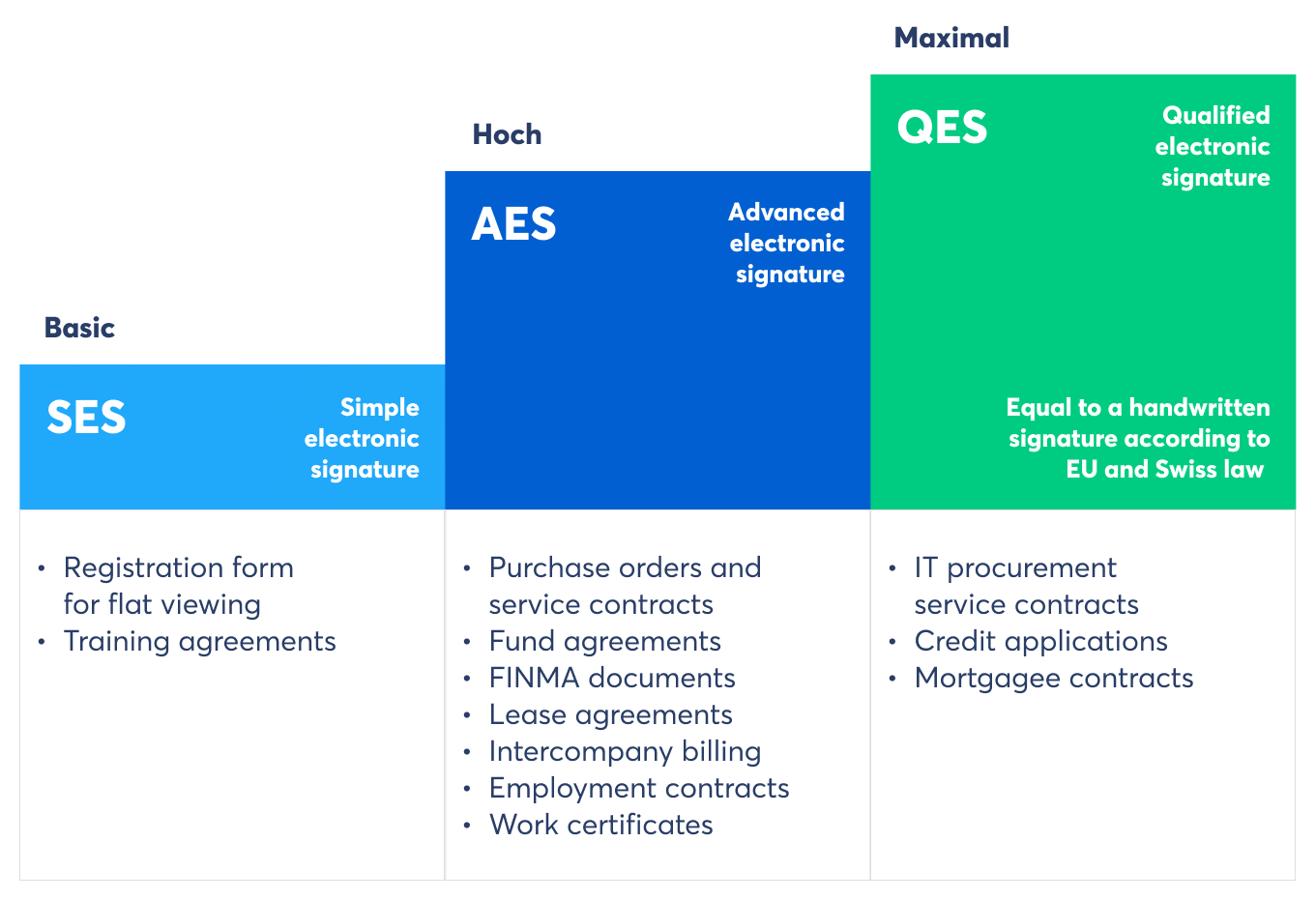
Mobiliar uses all three legally defined e-signature standards for different applications (Source: Skribble)
Legal aspects of qualified electronic signatures in Switzerland
The legal provisions for QES in Switzerland are governed by the "Federal Act on Certification Services in the Field of Electronic Signatures and Other Applications" (short: ZertES). The similarities to its EU counterpart (eIDAS) are significant.
Requirements for a valid Qualified electronic signature in Switzerland
The process of creating a QES involves the use of a digital signature and a digital certificate.
To sign in Switzerland with a qualified electronic signature, a digital certificate is necessary to confirm your identity. This digital certificate must meet the requirements of a so-called qualified certificate, which are precisely defined in the ZertES. Among other things, the certificate must include the name of the holder and the validity period.
The qualified certificate is issued by a state-recognized certification body. Before you can receive such a qualified certificate and sign with the QES in Switzerland, you must identify yourself there or at an authorized registration office (more on this below).
To create a QES, you ultimately need a suitable signature creation unit. Nowadays, this is typically done using software provided by an e-signature provider (such as Skribble).
Do you want to create a QES for Switzerland? We will explain that right in the next paragraphs.
In summary: Overall, the technical and legal requirements for the qualified electronic signature in Switzerland are very similar to those of the EU. However, they are two different jurisdictions – and mutual recognition of each other's e-signatures does not currently exist, even though it would be fundamentally possible according to ZertES.
Identification for the Swiss QES
You can identify for the QES in Switzerland either ...
- personally at a local registration office or
- online (e.g., video or self-identification)
... carry out. The option for online identification has only been available in Switzerland since March 2022 – since then, e-signing under Swiss law has become even easier and the last hurdles have been removed.
Certification bodies in Switzerland:
Recognized certification bodies in Switzerland include Swisscom AG and the Federal Office of Information Technology and Telecommunications (BIT). Here you can view a complete list of all recognized bodies in Switzerland.
Create a qualified electronic signature for Switzerland
Do you want to create a qualified electronic signature under Swiss law? Then you need to consider the following:
- First, look for a provider for e-signatures according to ZertES.
- Check if there is also a provider with qualified electronic signature in the range.
- Check if this provider also offers QES.
- Perform the identification at a recognized Swiss certification body.
- Sign using QES through the software of your chosen e-signature provider.
Tip: With Skribble, you get everything – e-signature, identification, and certificate – from a single source, as we collaborate with Swisscom AG for our electronic signatures, which issue qualified certificates according to ZertES (and eIDAS).
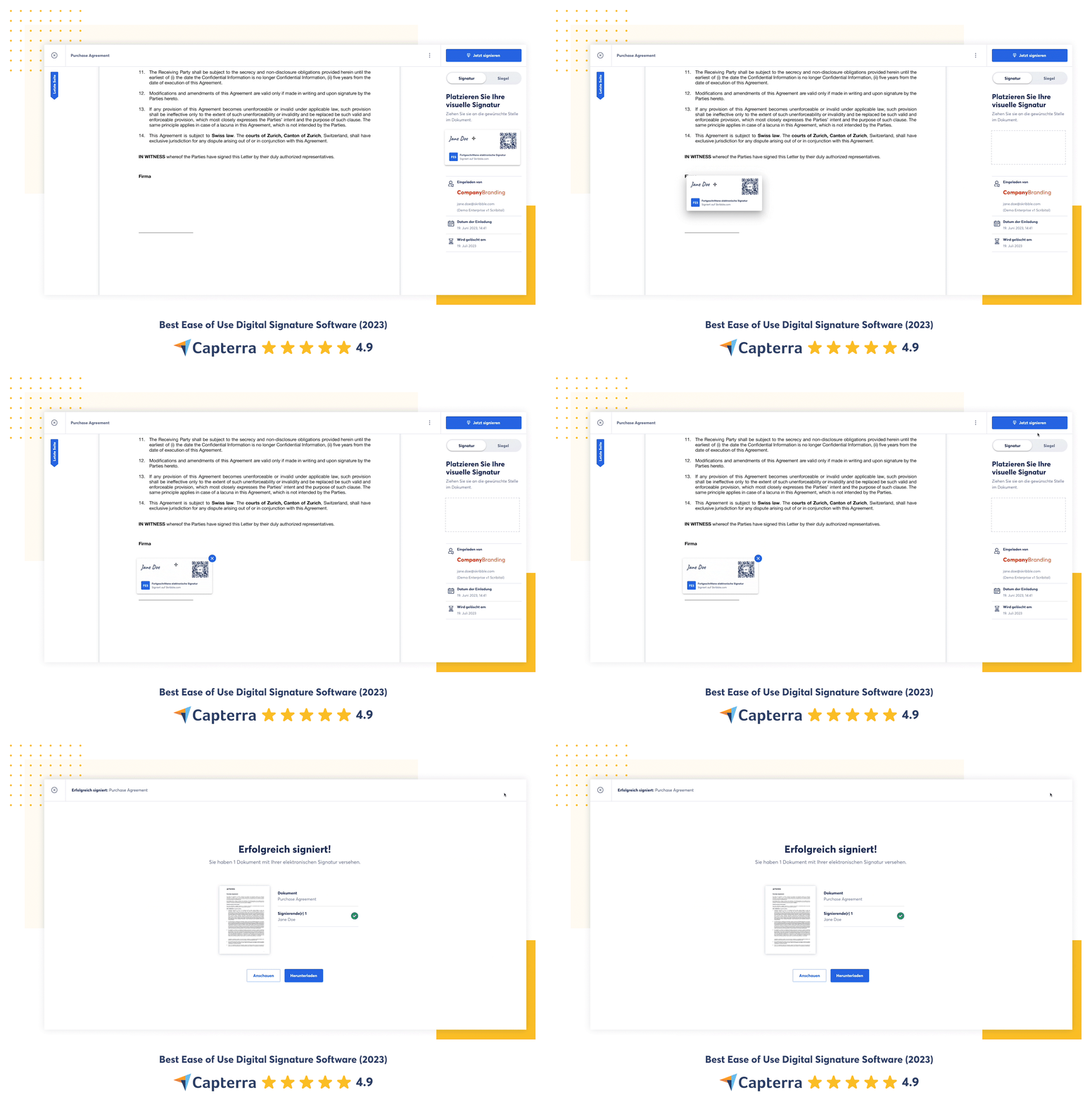
What documents require a QES under Swiss law?
In principle, it is as follows: Whenever Swiss law requires written form, you must use a QES for the document to be legally valid (unless you sign in the traditional way by hand).
What documents require written form in Switzerland? The following are included (selection):
- Consumer credit agreement (Art. 9 para. 1 KKG)
- Commercial traveler contract (Art. 347a Abs. 1 OR)
- Lease agreement (Art. 11 para. 1 KKG)
- Account with overdraft facility (Art. 12 para. 1 KKG)
- Revision report (Art. 728b para. 2 CO)
- Temporary employment contract (Art. 19 para. 1 AVG)
- Termination of lease agreements (Art. 266l para. 1 CO)
- Assignment of claims (Art. 165 para. 1 CO)
- Post-contractual non-compete clause in the employment contract (Art. 340 para. 1 CO)
Of course, you can also use the QES for other documents that do not have a formal requirement. While such informal documents are generally legally valid with any digital signature (including SES and AES), the QES offers the highest level of evidential strength and is particularly recommended for contracts with high liability amounts.
Exception: When is the QES not valid in Switzerland?
In rare cases, the law not only requires written form but also stipulates that the document must be handwritten (i.e., in the author's own handwriting). Examples include the handwritten will (Art. 505 Abs. 1 ZGB) and the surety (Art. 493 Abs. 1 OR). Here, even the QES – the highest of the three e-signature standards – is not sufficient, and a physical signature on paper is required.
Such a formal requirement is known as "qualified written form" in Switzerland, which can be confusing, as in some cases, the qualified electronic signature does not apply under this requirement.
Tip: You can find a detailed overview of what to consider when digitally signing Swiss contracts in our blog post on this topic.
QES in Switzerland – the trend is on the rise!
Signing with a qualified electronic signature has never been easier in Switzerland than it is now. With the option for online identification, the entire process can be handled digitally. We at Skribble can see this reflected in our usage numbers in Switzerland:
From 2020 to 2021, the use of QES in Switzerland increased sixfold. In 2022, usage then doubled again: the QES was used 12 times more often in 2022 than in 2020.
The QES is particularly commonly used for:
- Contracts in the HR area, such as employment contracts, NDAs, or references.
- Contracts in industries with high compliance requirements, such as insurance
- Official documents, such as submissions from law firms or public tenders
How do companies use e-signatures? You can read about it in our e-signing report!
Is the QES from the EU also valid in Switzerland (and vice versa)?
No, not in the sense that a QES according to EU standards is automatically recognized in Switzerland. The same applies vice versa. This is because the EU and Switzerland have not concluded an agreement to mutually recognize their electronic signatures.
Recognition still likely
However, the guidelines for creation are nearly identical in both jurisdictions. If a legal case arises challenging the validity of a Swiss QES in the EU, it is highly likely that such a lawsuit will not succeed.
Current case law in the Stadler Rail case
In autumn 2021, there was a precedent case here: The Swiss company Stadler Rail applied for a tender from the Austrian Federal Railways (ÖBB) – and was awarded the contract. However, the case went to court, because Stadler Rail had signed its bid with a Swiss QES, which is technically not valid in Austria. Ultimately, the court ruled in favor of the validity of the Swiss QES, and Stadler Rail was able to retain the contract.
Choose the right jurisdiction to save effort and costs
Even though the case of Stadler Rail ended without major consequences: Choosing the right jurisdiction for the QES from the outset can potentially save you from a lengthy court process. EU companies operating in Switzerland should therefore opt for a Swiss QES for Swiss legal transactions (and vice versa).
In some cases, it may also be beneficial to create the QES twice: once according to EU standards and once according to Swiss standards.
Would you like to try signing with the e-signature right away?
Your provider for qualified electronic signature from Switzerland
Skribble is dedicated to making electronic signing as simple as possible. You can sign with us effortlessly in just a few clicks – of course, while complying with all regulations.
Sign in all three e-signature standards
Simple, advanced, or qualified electronic signature? With Skribble, you get everything from a single source and can flexibly choose the right e-signature standard. You can obtain all necessary certificates through our platform, as we collaborate with recognized certification bodies – for both the Swiss and EU jurisdictions.
Especially practical: You can also handle the identification for the QES directly through Skribble. We offer various options for identification, including in-person verification or convenient online identification.
EU or Switzerland? You decide as needed!
As a Swiss provider, we naturally offer the QES according to Swiss law (ZertES). However, signing according to EU standards is also no problem for us – we provide the QES for both jurisdictions.
You can freely decide with each e-signature whether it should comply with the legal requirements of the EU or Switzerland:
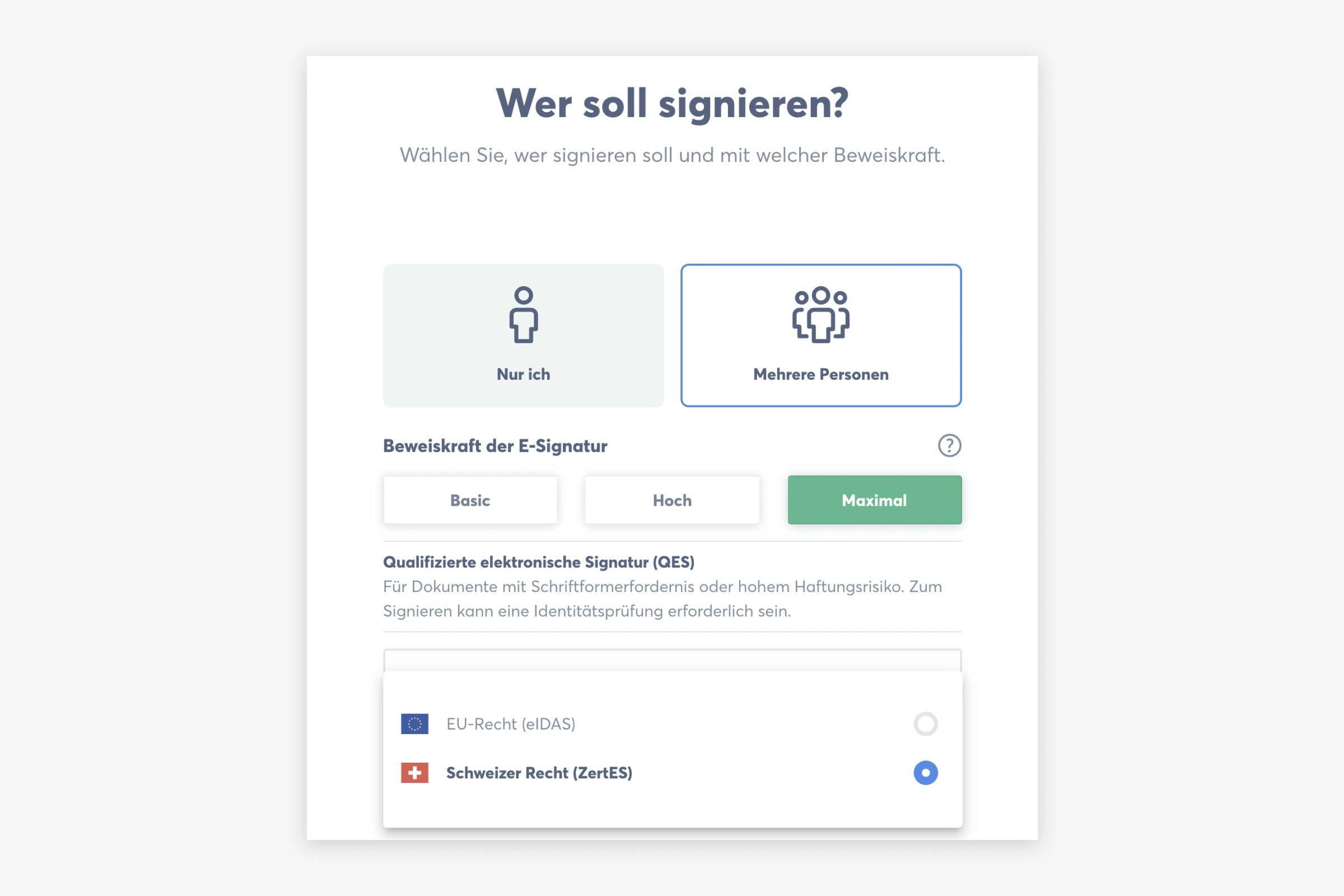
Choose whether you need an e-signature under Swiss law or EU standards.
In addition, you can choose the jurisdiction you use most frequently as your personal default setting:
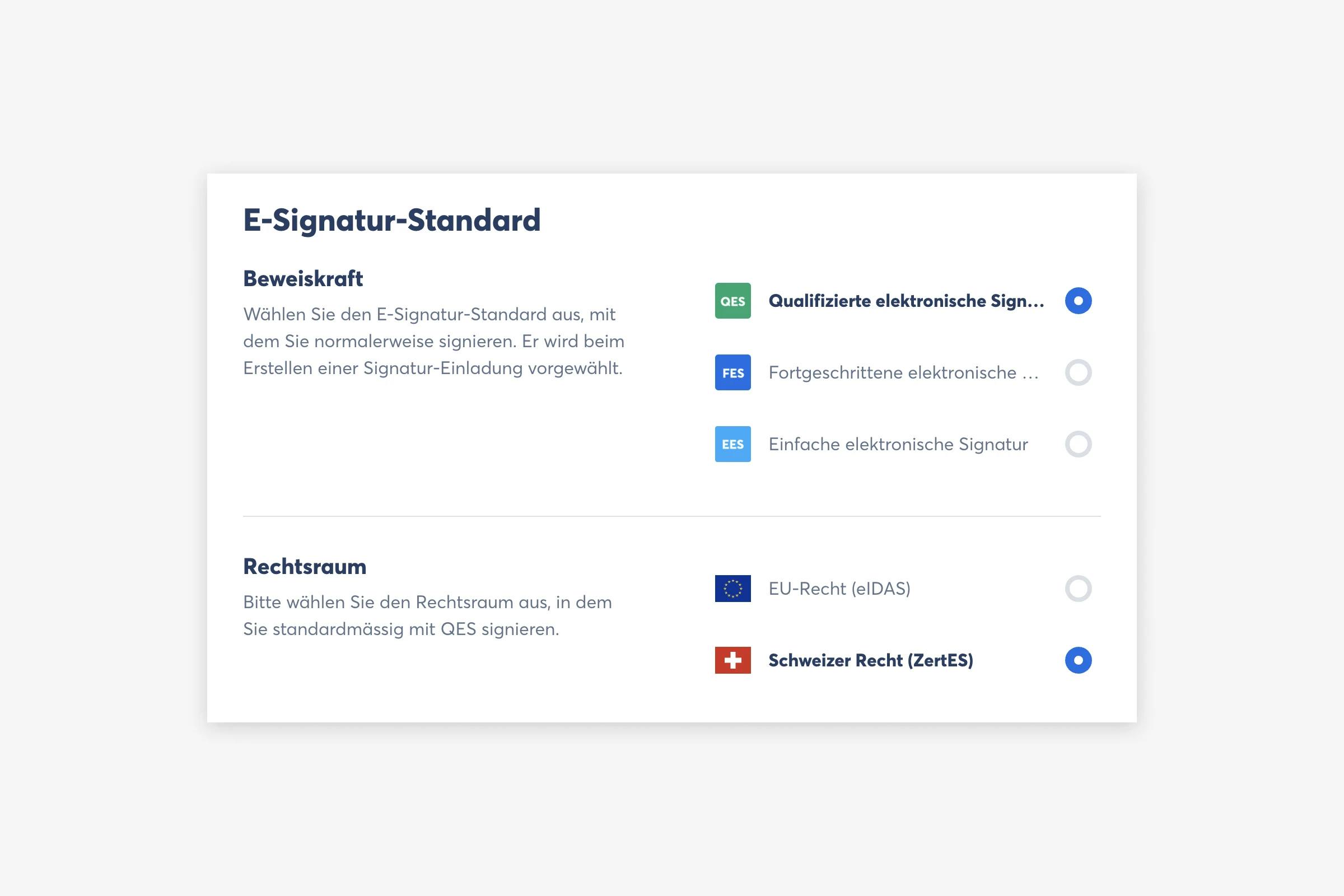
Choose the e-signature standard and the jurisdiction
Safe is safe: Hosting on Swiss servers
QES from Switzerland – this also means the highest security for your data. We store it (EU-compliant) on Swiss servers of the highest available standard (Tier IV). This corresponds to bank-level security.
Qualified electronic signature in Switzerland: Now also with video ID!
Signing with a qualified electronic signature in Switzerland is now even easier, as video identification has finally been made possible since 2022. This is a significant advancement, especially for non-Swiss individuals who require a QES according to Swiss standards. You can now complete the identification process under Swiss law from anywhere. Simply register at Skribble, identify yourself online, and start using the QES in Switzerland!
Frequently asked questions
The prices depend on the respective provider and the chosen pricing plan. With Skribble, you can pay for the QES either per piece or in a package. Here you can find our current prices and plans.


